Available model types
Model types are templates for models that define which objects a model can contain and how these objects relate to other objects. You can use the following model types to create new models.
The focused set of model types from ARIS Basic allows you to describe business processes, organizations, data structures and application systems.
 | Value-added chain diagram The Value-added chain diagram is mainly used to identify the functions within a company. The functions are directly involved in the creation of a company's added value. It can also provide a general overview of the processes in a company (process map). Processes are usually arranged in process categories and placed in a chronological order. They can also have hierarchies based on subprocesses. |
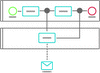 | Enterprise BPMN collaboration diagram Business Process Model and Notation (BPMN) is a graphical notation used to describe business processes. This model type can be used to represent control flows and message flows between partners involved in collaborative processes. Compared to models of type EPC there are many specific events, but limited options for modeling relationships with objects of other views. When you save a BPMN process, it is checked against BPMN modeling rules. If a rule is not followed, you will be informed about it directly in the model and in the Semantic checks bar. |
 | EPC The model type EPC (Event-driven process chain) is used to represent the control flow for a process. The functions belonging to the process are arranged in their chronological-logical order. Events trigger functions and are the result of functions. In contrast to a function, which is a time-consuming activity, an event refers to a point in time. The central modeling constructs are Event, Function, and Rule. These object types belong to the structurally relevant objects of the model type. |
 | Organizational chart An organizational chart primarily represents the following content: the organizational structure of a company, for example, departments, positions, employees), the organizational structure of a project (for example, groups, roles, employees), and the roles that exist in a company. |
 | Application system type diagram This model type is primarily used in Enterprise Architecture projects for describing application architectures. This includes the classification of software systems or software services in application system landscapes and the representation of the hierarchical structure and the functions of the software systems. |
 | IE Data model The data model is a graphical description language for semantic data models. The central object type is Entity type. The binary relationships between entity types are represented by connections. |
 | Structuring model This model type contains one object type, Structural element, and one connection type, contains. Since a structural element can be assigned all model types, this model has a wide range of uses. It is often used as a start model for various views of a company. |